Architecture
System Overview
Agent Identity Lab is a monorepo with two layers: packages (shared logic) and apps (deployable services). Five services form the control plane, all running locally via Docker Compose.
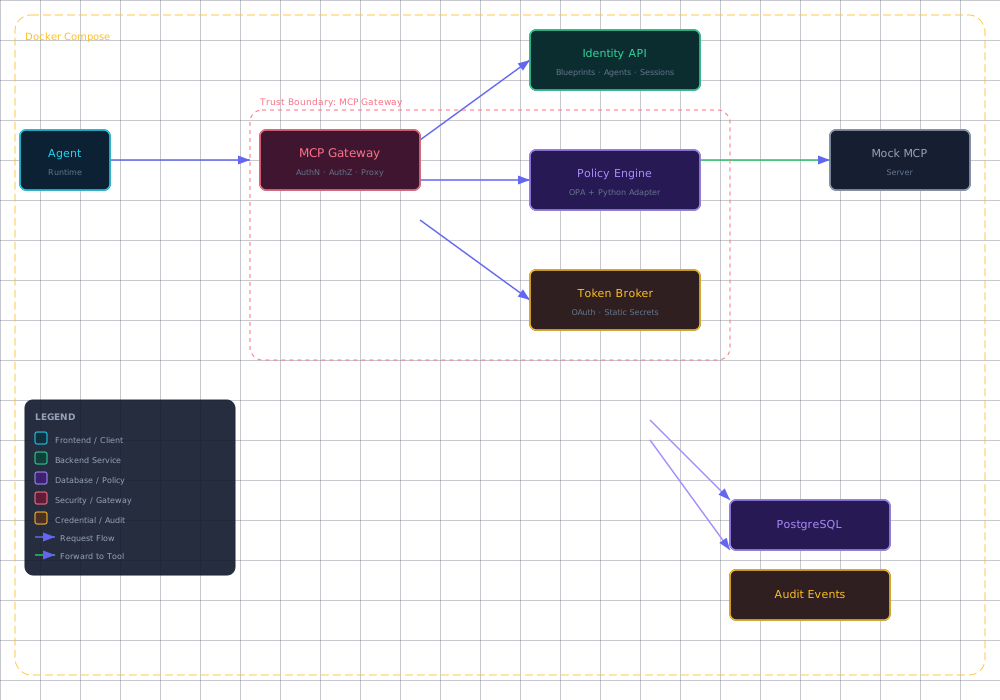
Service Boundaries
| Service | Port | Responsibility |
|---|---|---|
identity_api | 8000 | Blueprints, agents, sessions, delegation, authorization, audit |
token_broker | 8001 | Downstream credential issuance — agents never see raw API keys |
mcp_gateway | 8002 | AuthN/Z proxy between agents and MCP servers |
mock_mcp_server | 8003 | Test MCP server for development |
admin_ui | 3000 | Next.js dashboard (planned post-MVP) |
Data Flow
Agent → mcp_gateway → (auth check) → identity_api → policy_engine → token_broker → mcp_gateway → mock_mcp_server
                                                                                              ↓
                                                                                        audit log
Every request flows through the gateway, which authenticates the session token, calls the identity API for authorization, obtains downstream credentials from the token broker if allowed, and injects them server-side before forwarding to the tool.
Policy Engine
The policy engine supports two adapters:
- OPA (Open Policy Agent): Production-grade Rego policy evaluation via REST API. Fail-closed — if OPA is unreachable, access is denied.
- Python fallback: Local policy evaluator implementing scope intersection. Used when OPA is unavailable or for testing.
Authorization Model
Effective Scopes = User Scopes ∩ Agent Scopes ∩ Blueprint Scopes ∩ Tool Required Scopes ∩ Environment PolicyPolicy Decisions
| Decision | Meaning |
|---|---|
allow | All checks passed, effective scopes computed |
allow with reduced scopes | Some requested scopes removed by intersection |
deny | Any check failed — deny by default |
Token Model
Agent Session Tokens are signed JWTs with the following claims:
| Claim | Description |
|---|---|
sub | Agent principal URI (agent:uuid) |
aud | mcp-gateway |
agent_id | Agent UUID |
blueprint_id | Blueprint slug + version |
acting_user | Human user ID (null for machine-only) |
scopes | Effective scopes after intersection |
runtime_digest | Container image SHA |
trace_id | Request trace identifier |
exp | Expiration (max 30 minutes) |
Asymmetric RS256 signing. Tokens are validated on every gateway request.
Security Architecture
Attestation
Runtime attestation binds agent sessions to execution context:
- Runtime generates claims (container digest, git commit, environment, framework, model)
- Claims are signed with the agent’s registered private key
- Identity service verifies: signature, timestamp freshness (5 min window), nonce uniqueness
Credential Isolation
Agents never receive raw downstream credentials:
- Agent requests a tool via the MCP Gateway
- Gateway authenticates the session and authorizes the action
- Token Broker issues a short-lived downstream credential
- Gateway injects the credential server-side in the forwarded request
- Only credential lease metadata is logged — no raw secrets
Audit Chain
Every decision is recorded in a tamper-evident append-only chain:
record_hash = SHA256(previous_hash + canonical_event_json)The chain can be verified via POST /v1/audit/verify-chain. Any tampering is detected as a hash mismatch.
Key Design Decisions
Agents are uniquely identifiable security principals, not shared service accounts or personal credentials.
Effective permissions are the intersection of user, agent, blueprint, tool, and environment constraints — never the union.
Downstream credentials are injected by the gateway, not exposed to agent runtimes.
All agent-to-tool traffic flows through the MCP Gateway. No direct agent access to tools.